
Choosing the right commercial refrigeration equipment is an important decision for restaurants, hotels, supermarkets, catering businesses, and other foodservice operations.
A reliable commercial refrigerator or freezer helps businesses store food safely, organize inventory, maintain consistent temperatures, and support efficient kitchen operations. BORYVA’s commercial reach-in collection includes refrigerator and freezer configurations for different commercial applications.
However, commercial refrigeration equipment comes in many configurations. Buyers need to consider more than just the price or external appearance. Door types, storage capacity, temperature requirements, construction materials, compressor configuration, and available space all affect the purchasing decision.
This guide explains how to choose commercial reach-in refrigerators and freezers, compare different configurations, and identify the features that matter most when purchasing equipment for a commercial kitchen.
1. What Is a Commercial Reach-In Refrigerator or Freezer?
A commercial reach-in refrigerator or freezer is an upright refrigeration unit designed to provide convenient access to stored food and ingredients through front-opening doors.
Unlike walk-in coolers and freezers, reach-in units are designed for direct access without requiring employees to enter the storage compartment.
They are commonly used in:
- Restaurants and commercial kitchens
- Hotels and catering facilities
- Bakeries and pastry kitchens
- Supermarkets and grocery stores
- Cafeterias and institutional kitchens
- Food preparation and storage areas
Commercial reach-in refrigerators are primarily used for chilled food storage, while commercial reach-in freezers are designed for frozen food storage. Depending on the application, businesses can choose solid door models for back-of-house storage or glass door models when product visibility is important.
2. Commercial Refrigerator vs. Commercial Freezer: What Is the Difference?
Although commercial refrigerators and commercial freezers may have similar cabinet structures, they serve different storage requirements. For current BORYVA configurations, compare the reach-in refrigerator range and reach-in freezer range.
Commercial Refrigerator
A commercial refrigerator maintains chilled storage conditions for ingredients and perishable products that require refrigeration rather than freezing.
Common applications include:
- Fresh vegetables and fruits
- Dairy products
- Meat and seafood requiring refrigerated storage
- Prepared ingredients
- Sauces and food preparation supplies
- Beverages and packaged food
For restaurant kitchens, a commercial kitchen refrigerator helps keep frequently used ingredients organized and accessible during food preparation.
Commercial Freezer
A commercial freezer is designed for frozen food storage and operates at lower temperatures than a refrigerator.
Common applications include:
- Frozen meat and poultry
- Seafood
- Frozen vegetables
- Ice cream
- Frozen ingredients
- Prepared frozen food
When choosing a commercial freezer, buyers should consider the required storage temperature, insulation, door sealing, temperature control, and expected frequency of door opening.
Important: Refrigerators and freezers are not interchangeable. Always select equipment according to the food storage requirements and applicable food safety regulations in the intended market.
3. Solid Door vs. Glass Door Commercial Refrigerators and Freezers
One of the most important decisions when purchasing commercial refrigeration equipment is choosing between solid doors and glass doors. Each option offers different advantages depending on the application.
Solid Door Commercial Refrigerator and Freezer
Solid door models are commonly used in commercial kitchens and back-of-house food storage areas. Buyers can review an existing solid-door commercial reach-in refrigerator and solid-door commercial reach-in freezer as references when comparing this configuration.
Their main advantages include:
- Suitable for concealed food and ingredient storage.
- Help maintain an organized storage environment.
- Provide an opaque cabinet design for kitchen operations.
- Suitable for restaurants and foodservice facilities that prioritize storage functionality.
- Available in different door configurations to accommodate various storage requirements.
Solid door reach-in refrigerators and freezers are often a practical choice for kitchens where staff need reliable access to stored ingredients without requiring product visibility from outside.
Glass Door Commercial Refrigerator and Freezer
Glass door models allow users to see the contents without opening the cabinet. For a direct comparison, see the existing glass-door commercial reach-in refrigerator and glass-door commercial reach-in freezer pages.
They can be useful in applications where product visibility and inventory checking are important.
Potential advantages include:
- Easier visual inventory checks.
- Better visibility of stored products.
- Suitable for certain foodservice, retail, and display applications.
- Can be combined with interior LED lighting.
- Help staff identify products without repeatedly opening doors.
For glass door models, buyers should also evaluate glass construction, condensation management, lighting, door sealing, and the intended operating environment.
Which One Should You Choose?
| Selection Factor | Solid Door | Glass Door |
|---|---|---|
| Product visibility | Limited | Clear visibility |
| Typical application | Back-of-house storage | Storage and product visibility |
| Inventory checking | Requires opening the door | Easier visual checking |
| Display function | Limited | More suitable |
| Appearance | Traditional commercial kitchen design | More visual and open |
The right option depends on how the equipment will be used. A restaurant kitchen focused on ingredient storage may prefer solid doors, while an operation that benefits from product visibility may choose glass doors. For a deeper comparison, see BORYVA’s Solid Door vs. Glass Door Commercial Refrigerators guide.
4. Single Door vs. Two Door vs. Three Door Commercial Refrigerators and Freezers
Commercial reach-in refrigerators and freezers are available in different door configurations. Choosing the right number of doors helps businesses balance storage capacity, available floor space, and daily operating requirements.
Single Door Commercial Refrigerator or Freezer
Single door models are suitable for businesses with relatively limited storage requirements or restricted kitchen space.
- Small restaurants
- Coffee shops
- Small food preparation areas
- Compact commercial kitchens
- Supplementary food storage areas
Two Door Commercial Refrigerator or Freezer
Two door models provide additional storage space and are commonly considered by restaurants and foodservice businesses with greater inventory requirements.
- More storage space than many single-door configurations.
- Easier organization of different ingredients.
- Suitable for medium-sized kitchens.
- Flexible storage arrangements.
Three Door Commercial Refrigerator or Freezer
Three door models are designed for operations that require larger storage capacity and more organized inventory management. They may be suitable for large restaurants, hotel kitchens, catering facilities, high-volume food preparation operations, and commercial foodservice establishments.
How Do You Choose?
Before selecting a door configuration, consider:
- How much refrigerated or frozen inventory do you normally store?
- How much floor space is available?
- How frequently do employees access the equipment?
- Do you need separate storage zones for different ingredients?
- Will the equipment support your expected business growth?
Do not choose a larger unit simply because it offers more storage. The cabinet dimensions, available kitchen space, workflow, and actual storage needs should all be considered.
5. Why Stainless Steel Matters in Commercial Refrigeration
Stainless steel is widely used in commercial kitchen refrigeration because it offers practical benefits for demanding foodservice environments. When evaluating a stainless steel commercial refrigerator or freezer, buyers should look at both the external cabinet and internal construction.
Stainless Steel Construction
A suitable stainless steel cabinet can help support daily commercial use and routine cleaning. Buyers should confirm the actual stainless steel grade and which components use stainless steel, rather than assuming the entire cabinet has the same material specification.
Adjustable Shelving
Adjustable shelves allow users to organize ingredients, containers, and food packages according to their storage requirements. Before purchasing, check shelf dimensions, shelf load capacity, the number of included shelves, available shelf adjustment positions, and compatibility with commonly used food containers.
Door Gaskets
Removable door gaskets can make routine cleaning and replacement more convenient. Check the gasket design, sealing performance, and availability of replacement parts.
Cabinet Insulation
Insulation is an important part of commercial refrigeration construction. Buyers should evaluate insulation materials, cabinet thickness, and overall cabinet design when comparing different equipment models.
6. Temperature Control and Cooling Performance
Temperature control is one of the most important factors when selecting commercial refrigeration equipment. A refrigerator and a freezer have different temperature requirements, and the correct operating range depends on the food being stored and the applicable food safety standards.
Commercial Refrigerator Temperature
Commercial refrigerators are used to maintain chilled storage conditions. Buyers should check available temperature settings, the digital temperature controller, temperature consistency, air circulation design, temperature recovery after door openings, and alarm or monitoring functions, if available.
Commercial Freezer Temperature
Commercial freezers require lower operating temperatures than refrigerators. When comparing commercial freezers, evaluate the specified operating temperature range, cooling system configuration, insulation performance, door sealing, temperature controller accuracy, and suitability for the intended frozen products.
Do not select a freezer based only on its advertised temperature range. Consider the operating environment, loading conditions, and actual application.
7. Top-Mount vs. Bottom-Mount Compressor
Compressor location is another consideration when choosing a commercial reach-in refrigerator or freezer. Different compressor configurations can influence maintenance access, cabinet layout, and how the equipment fits into the kitchen.
Top-Mount Compressor
Top-mounted compressor designs position the refrigeration system above the storage compartment. Depending on the model, this arrangement may offer a different approach to kitchen floor-level equipment layout, convenient access to certain refrigeration components, and a design that may suit particular installation environments.
Bottom-Mount Compressor
Bottom-mounted compressor designs position the refrigeration system near the lower section of the cabinet. Depending on the design, they may offer convenient access to the upper storage area, a different arrangement for service and maintenance, and potentially easier access for certain maintenance tasks.
Neither configuration is universally better. Buyers should compare the equipment design, installation conditions, maintenance access, and manufacturer specifications.
8. Capacity, Dimensions and Kitchen Space
A commercial refrigerator or freezer must fit both the available kitchen space and the business’s storage requirements. Before purchasing, measure the intended installation area carefully.
Check External Dimensions
- Cabinet width
- Cabinet depth
- Cabinet height
- Door opening clearance
- Access routes for delivery and installation
- Required ventilation and clearance space
Consider Internal Storage Capacity
External dimensions alone do not determine how much usable storage space is available. Compare internal cabinet dimensions, usable storage volume, shelf configuration, number of shelves, door layout, and storage requirements for different food products.
Consider Kitchen Workflow
The refrigerator should be positioned where employees can access ingredients efficiently without interfering with food preparation or other kitchen operations. A well-planned installation can help improve kitchen organization and daily workflow.
9. Energy Efficiency, Refrigerant and Maintenance
Commercial refrigeration equipment operates regularly, so buyers should consider long-term operating costs in addition to the initial purchase price.
Energy Efficiency
When comparing equipment, evaluate its actual energy consumption and applicable efficiency information. Important factors include compressor performance, insulation design, door sealing, lighting, defrost system, operating environment, and frequency of door opening. Look for verified energy consumption data and applicable certifications rather than relying on general marketing claims.
Refrigerant Selection
Refrigerant type is another important purchasing consideration. Some commercial refrigeration products use R290 refrigerant. Buyers should confirm refrigerant type, compliance with applicable local regulations, equipment safety requirements, installation and service requirements, and availability of qualified technicians. R290 is a flammable refrigerant, so equipment designed for it must be installed and serviced according to applicable safety requirements.
Routine Maintenance
Regular maintenance helps support reliable equipment operation.
- Clean the interior and exterior regularly.
- Inspect and clean condenser components according to the manufacturer’s instructions.
- Check door gaskets for damage or poor sealing.
- Avoid blocking air circulation inside the cabinet.
- Monitor operating temperatures.
- Arrange professional inspection when abnormal operation occurs.
Always follow the equipment manufacturer’s maintenance instructions.
10. How to Choose a Reliable Commercial Refrigerator Manufacturer
For distributors, importers, restaurant equipment suppliers, and private-label buyers, selecting the right manufacturer is just as important as choosing the right product. A reliable commercial refrigerator manufacturer should be able to provide clear specifications, consistent production, quality control, and suitable customization support.
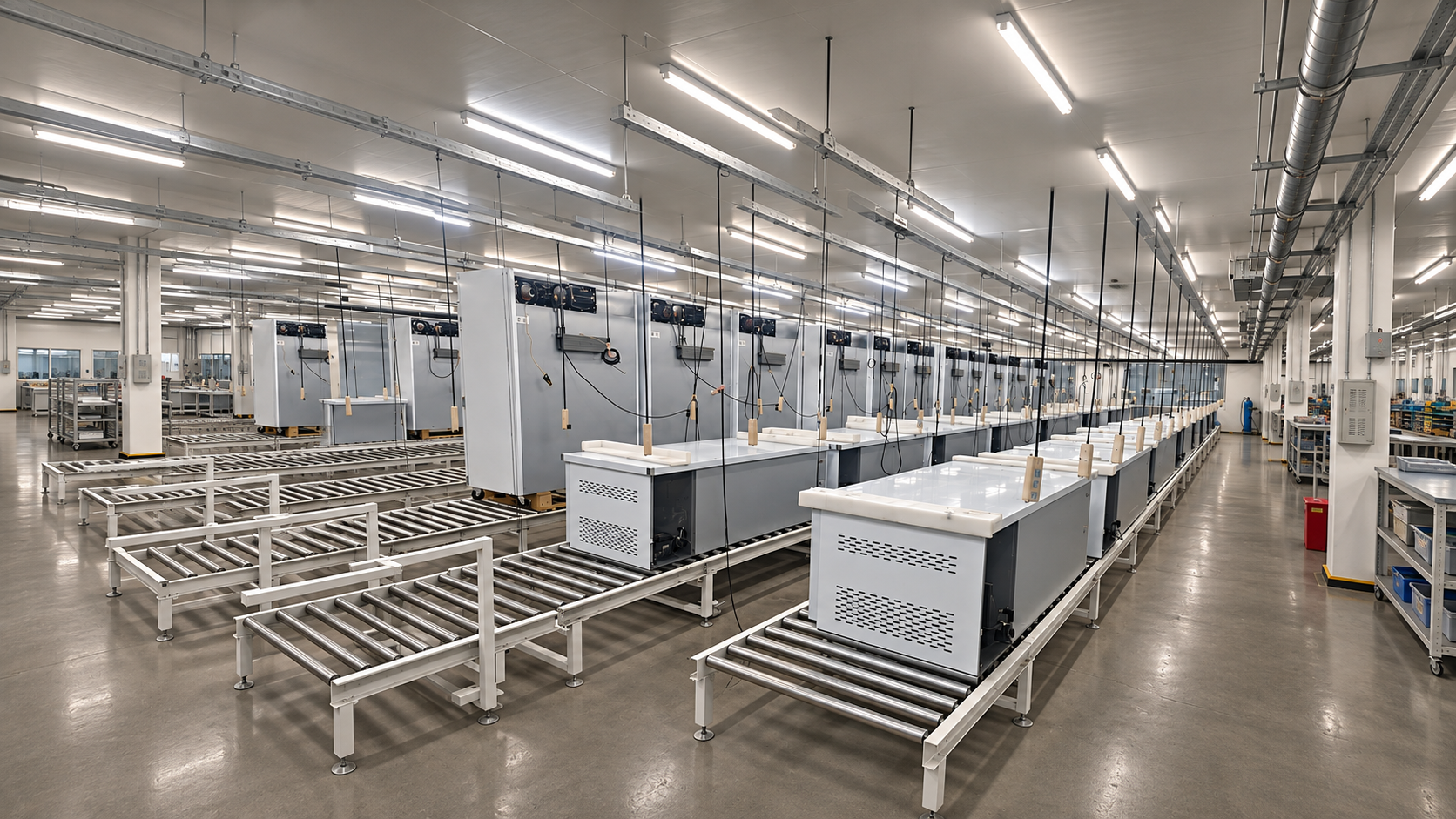
The factory testing-line image above illustrates the type of production and inspection environment buyers may want to understand when evaluating a manufacturing partner. It does not replace product-specific documentation or inspection records.
Product Range
Check whether the manufacturer offers different refrigeration configurations, including commercial reach-in refrigerators, commercial reach-in freezers, single door, two door, and three door models, solid door and glass door options, and different cabinet dimensions and configurations. A broad product range can make it easier to source multiple products from one manufacturing partner.
Manufacturing and Quality Control
Ask about the manufacturer’s production processes and inspection procedures. Useful questions include whether products are inspected before shipment, whether refrigeration systems are tested, whether electrical components are checked, whether product specifications are documented, and whether product inspection records can be provided.
OEM and ODM Customization
For distributors and private-label businesses, customization can be an important purchasing factor. Depending on the manufacturer’s capabilities, customization options may include brand logo and product labeling, cabinet appearance and color, door configurations, shelf arrangements, voltage and plug configurations, packaging, and user documentation. Always confirm the available customization scope, minimum order quantity, lead time, and technical feasibility before placing an order.
Warranty and After-Sales Support
Before selecting a supplier, clarify warranty coverage, compressor warranty, spare parts availability, technical support, troubleshooting assistance, and packaging and transportation arrangements. A reliable supplier should provide clear warranty terms and practical after-sales support.
Conclusion: Choose the Right Commercial Refrigeration Equipment for Your Business
Choosing the right commercial reach-in refrigerator or freezer requires careful consideration of storage requirements, door configuration, construction, temperature control, installation conditions, and long-term operating costs.
Whether you need a single-door refrigerator for a compact kitchen, a two-door freezer for restaurant operations, or a three-door stainless steel refrigeration unit for a larger foodservice facility, the best choice depends on your actual business requirements.
For distributors, importers, and commercial kitchen equipment buyers, working with an experienced manufacturer can also help simplify product sourcing and customization.
BORYVA provides commercial refrigeration equipment solutions for business buyers seeking different product configurations and OEM/ODM support.
Looking for commercial refrigerators or freezers for your business? Contact BORYVA to discuss your product requirements, explore available configurations, and request a quotation.
Frequently Asked Questions
What is the difference between a commercial refrigerator and a commercial freezer?
A commercial refrigerator is designed for chilled food storage, while a commercial freezer is designed for frozen food storage at lower temperatures.
What is a reach-in refrigerator?
A reach-in refrigerator is an upright commercial refrigeration unit with front-opening doors that allow employees to access stored food and ingredients directly.
What is the difference between a reach-in refrigerator and a walk-in cooler?
A reach-in refrigerator is a self-contained upright cabinet, while a walk-in cooler is a larger refrigerated room that employees can enter to access stored products.
Is a glass door or solid door commercial refrigerator better?
Solid door models are commonly used for back-of-house food storage. Glass door models provide better product visibility and can be useful when visual inventory checks are important.
Should I choose a one-door, two-door, or three-door commercial refrigerator?
The choice depends on your storage volume, kitchen space, inventory organization, and daily usage. Smaller operations may prefer single-door models, while larger kitchens may require two-door or three-door configurations.
Why are stainless steel commercial refrigerators popular?
Stainless steel is commonly used in commercial kitchens because it is practical for routine cleaning and suitable for demanding foodservice environments. Buyers should confirm the material grade and actual construction of each model.
What should I check before purchasing a commercial freezer?
Check the required temperature range, storage capacity, cabinet dimensions, insulation, door sealing, compressor configuration, electrical requirements, and maintenance support.
Can commercial refrigerators and freezers be customized?
Depending on the manufacturer, customization may include branding, cabinet appearance, door configuration, shelving, electrical specifications, and packaging. Confirm available options and minimum order quantities directly with the manufacturer.
What should I look for in a commercial refrigeration manufacturer?
Evaluate the manufacturer’s product range, production capabilities, quality inspection procedures, technical documentation, customization options, warranty terms, and after-sales support.
Are commercial reach-in refrigerators suitable for restaurants?
Yes. Commercial reach-in refrigerators are widely used in restaurant kitchens because they provide accessible refrigerated storage for ingredients and prepared food. The appropriate model depends on the kitchen’s storage requirements and available space.
4 Responses